The diamond needs a base
I started my career at the bottom of the pyramid, as most of us did, and a fair share of what I did in those first years an agent would now finish before my coffee got cold. Was it glamorous? Not remotely, but it is where I learned how a business actually makes money, and I keep wondering how young people will get that education in an AI-first world.
Jim Lecinski, who teaches AI and marketing strategy at Kellogg, wrote one of the clearest pieces I have read on this. In 3 ways frontier CMOs should rewire marketing teams for the human-AI era, he argues that leaders are asking the wrong first question. The useful one isn't how many people AI lets you cut, but what shape and skill mix your organisation needs, because execution work shrinks while the layers that orchestrate, supervise and decide grow. His Kellogg colleague Harry Kraemer and his co-authors gave the resulting shape a name: the diamond. A narrow base, a wide middle and the same small top.
I agree with Jim Lecinski's diagnosis, and his starting point is the most practical I have seen. Map the three to five workflows that matter, then decide for each one who commissions the work, who performs it, who checks it and who approves it. But my sense is that the diamond describes the people you have today, not how you get the people you need in five years.
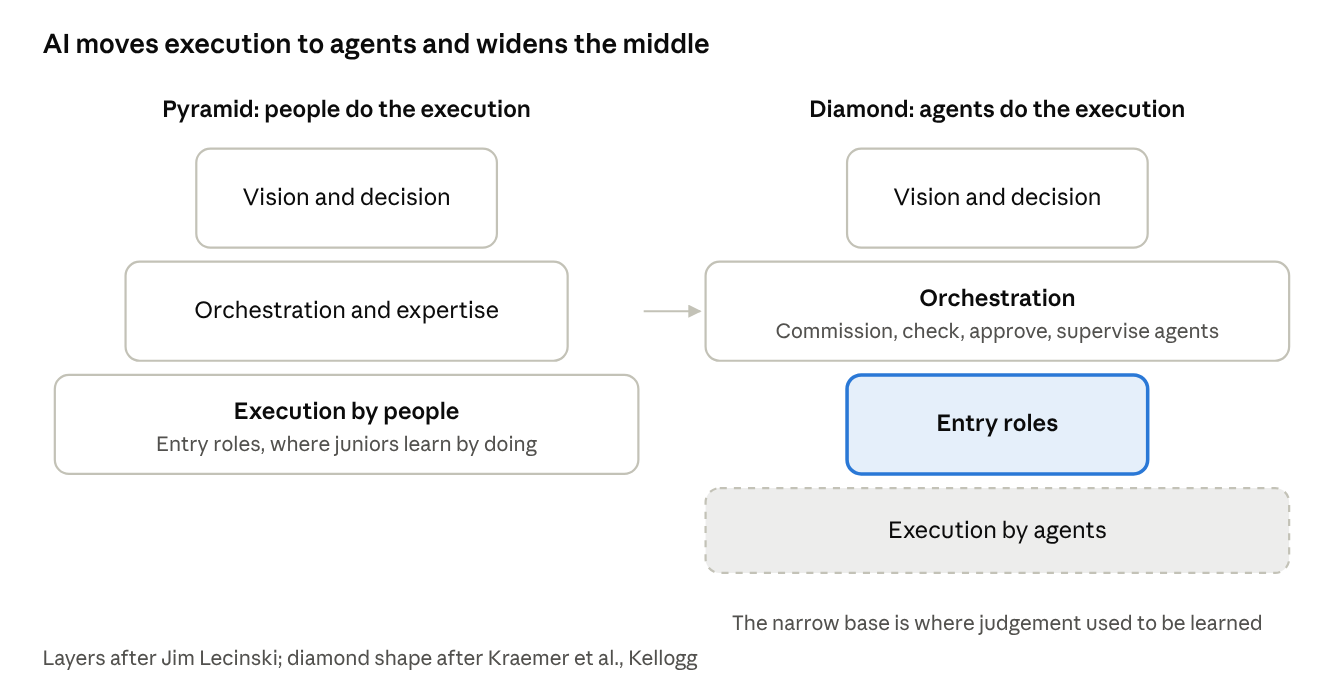
That gap matters because of how people actually learn a craft. In 1991 the anthropologist Jean Lave and the educational theorist Etienne Wenger studied apprenticeships, from tailors in Liberia to midwives in Mexico, and called what they saw legitimate peripheral participation. Newcomers learn by doing real work at the edge of the craft, low risk and closely watched, and move towards the centre as their judgement grows. That edge is exactly the base AI is now absorbing. The cognitive psychologist Lisanne Bainbridge described the other half of the problem back in 1983, in a paper called Ironies of automation: automate the routine parts of a job and the humans keep only the hardest exceptions, while losing the daily practice that taught them how to handle those exceptions. Put the two together and you get the real risk of the diamond. The wide middle is expected to hold all the judgement, but the place where judgement used to be formed is gone.
That leaves four questions I don't think anyone has fully answered.
How do we prepare young people for a career that starts in the middle?
Most education still grades students on producing the output, which is the part that has become cheap. Young people need to graduate having framed a problem, commissioned the work from an agent, found what was wrong with it and defended a recommendation anyway. Jim Lecinski suggests asking early-career candidates to show an end-to-end AI workflow they built themselves. I would make that the graduation project, and I would ask companies to co-own it with universities, because peripheral participation only works if somebody offers a periphery in the real world.
How do we reskill the people already at work?
The McKinsey figures Jim Lecinski quotes show people feel equal parts excited and terrified: 86% of marketers are excited about AI, 57% are anxious about their roles and only 28% see their company pursuing a fundamental rewiring. A quarterly AI seminar won't close that gap. People reskill when they redesign their own workflow with a manager who coaches them through it, so they forge the plan, you vet it together, and the new skill sticks because it is attached to work they own in practice.
How do companies make the transition?
Jim Lecinski's advice to redesign one AI-affected team before touching the whole org chart gives you a testing ground without the risk of getting it all wrong, and a place to try out what the new entry role looks like. My bet is that the checking step becomes the new apprenticeship. Juniors who review, correct and escalate agent output can learn the business faster than I did, as long as someone senior reviews their reviews. Enter the world of meta-reviewers. This will be slower and more expensive in year one, which is why the tempting alternative is to stop hiring juniors altogether and buy the middle on the market instead.
For a while, that works, but only as long as somebody else is still training them. The economist Gary Becker explained the trap in his work on human capital in the 1960s: companies underinvest in general skills because a trained person can walk out of the door and take those skills to a competitor. So every company has a perfectly rational reason to let someone else carry the cost of the base. If they all make that choice at once, the market for experienced people slowly runs dry and the price of whoever is left goes all the way up.
The second problem is what you are actually buying. Becker separated general skills, which travel, from firm-specific ones, which don't, and the middle of a diamond runs on the second kind: the feel for how your particular business makes money and where its unwritten rules sit. An external hire brings the general part and spends a year learning the rest. And the orchestration work Jim Lecinski describes is so new that nobody has ten years of it, so the experienced middle of 2031 has to be formed inside today's workflows. Could agents take over part of the middle as well? I think they will, and the diamond may thin out further. But Bainbridge's irony applies again: the fewer humans left in the loop, the more each one has to know, and the less practice they get at it.
How do leaders lead people and agents at the same time?
Leading agents is management by specification, and it only works when the specification is largely correct. You define the task, set the guardrails, check the output and ideally stand behind the result. Leading people works almost the other way round, with context in place of instructions and enough psychological safety that someone will tell you the plan is wrong before it costs you. The trap I worry about is leaders who get very good at the first and start managing their teams the same way. Agents rarely push back, if anything they over-affirm, and a team that has learnt to stay quiet looks exactly like a team that agrees with you. The accountability stays human either way, and so does the job of growing the next leader.
I learned my craft at the bottom of a pyramid, in work that looked unimportant and probably wasn't in the grand scheme of things. I'm fairly sure the diamond is the right shape for what comes next, but I would hate for us to build it by sawing off the first rung of the ladder. Picturing the organisation of the future takes imagination, the collective kind most of all, and preparing for it has to start today across the entire chain, from education to individual contributors and leaders.